
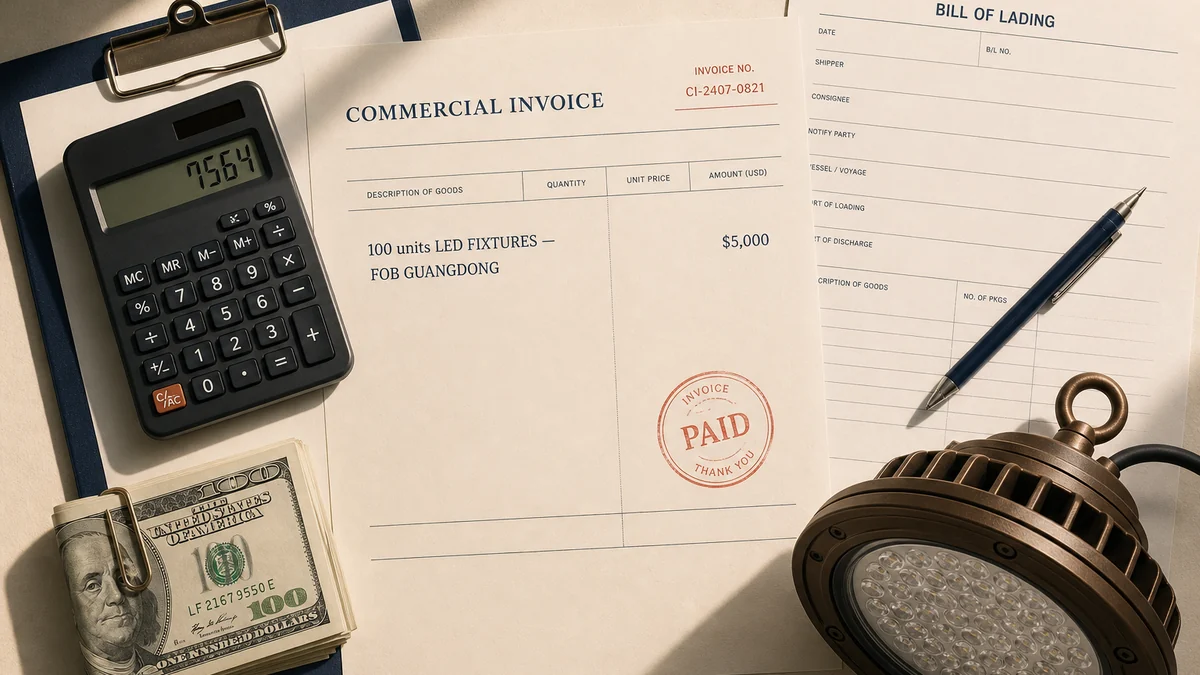
A $5,000 invoice for 100 industrial waterproof LED fixtures from Guangdong, ocean LCL to Long Beach. By the time the pallet hits the importer's warehouse in Riverside, the actual cash out the door is $7,500. Per-unit cost: $75 — a 50% markup over the FOB invoice price.
That's not a worst case. That's a routine 2026 China-to-US shipment with one Section 301 layer applied. And the most common reason importers get this number wrong by 10–20% is that they're confusing what their supplier means by FOB or CIF with what CBP means by transaction value.
The two are not the same thing. Mixing them up is how a $5,000 invoice ends up taxed as if it were $5,800. Or how an importer leaves money on the table by paying duty on freight they didn't have to.
This piece breaks down the actual math: what each Incoterm covers, what CBP cares about, and what a realistic landed-cost model looks like in 2026.
What CBP actually values
The starting point: CBP doesn't care about Incoterms in the abstract. CBP cares about transaction value — the price actually paid or payable for the goods when sold for exportation to the United States, with specific statutory adjustments.
Transaction value is the goods price. Not the goods-plus-freight price. Not the goods-plus-freight-plus-insurance price. International freight and insurance are not part of the dutiable value for US imports, even when they appear on the same invoice.
This is where Incoterms enter the picture, and where importers trip.
If your supplier quotes FOB Shanghai $5,000, you're paying $5,000 for the goods, picking up freight separately. The $5,000 is the transaction value.
If your supplier quotes CIF Long Beach $5,800, the $5,800 includes the goods, the international freight, and the insurance. CBP wants to value the goods at $5,000, which means you (or your broker) need to back out the freight and insurance — usually $800 in this scenario — using a properly itemized invoice or a rated bill of lading. If the freight isn't separately stated and provable, CBP can value the entire $5,800.
If your supplier quotes EXW Guangdong factory, you're picking up the goods at the factory and arranging everything yourself. Domestic Chinese trucking, port handling, ocean freight, customs at both ends — all on you. The dutiable transaction value is just the EXW price.
If your supplier quotes DDP Riverside, the supplier handles everything including US duties. The transaction value question gets complicated because duties are baked into the quote — and there are valuation rules about back-deducting duties paid by the seller. DDP from China is also a structure CBP scrutinizes, because it can mask origin and valuation issues.
The practical implication, in one sentence: always work from the goods-only price for duty calculation, even if your supplier insists on quoting CIF or DDP. If the invoice is bundled, ask for an itemized version. Without an itemization, you may pay duty on freight, which is roughly $40–$200 of duty per pallet on a typical China-to-US shipment.
The 2026 duty stack on that $5,000 LED shipment
Let's run the actual numbers on the LED fixture example. Assume the goods are properly classified at HTS 9405.40 (a common subheading for LED luminaires, rates vary by subheading). For this worked example we'll use a 6% MFN rate.
Worked example: 100 LED fixtures, FOB Guangdong $5,000
- Goods (FOB) value: $5,000
- Ocean freight + drayage: $800 (separately invoiced, not dutiable)
- MFN duty (6%): $300 — applied to FOB value, not freight
- Section 301 (List 3, 25%): $1,250 — applied to FOB value, on top of MFN
- MPF (0.3464%): ~$32.71 (the 2026 minimum kicks in for this size)
- HMF (0.125% on ocean cargo): ~$6.25
- Insurance (estimated 1% of cargo value): ~$100
- Customs broker fee: ~$125
- Documentation & handling: ~$50
- Total landed cost: approximately $7,564
- Per unit (100 units): ~$75.64

A 51% markup over the FOB invoice. The biggest single line item, by far, is Section 301. Without that layer, the same shipment lands around $6,300 — still a 26% markup, but materially different.
Two things to notice in that math.
Duty applies only to the FOB value. The $800 of ocean freight is not dutiable. Importers who model duty on the CIF total — because that's the number on the bundled invoice — overstate duty by 6–25% of the freight value, depending on the rate stack.
MPF and HMF are real. They're small in absolute terms (under $40 here) but they're flat percentages with a minimum. On a $50 sample shipment they don't matter; on a $50,000 commercial shipment they're $173 + $63 = $236, and on a $500,000 shipment the MPF caps at $634.62. They go in the model, always.
The first-sale shortcut
Here's where serious importers leave money behind. The Section 301 layer is calculated as a percentage of transaction value. Lower the transaction value, lower the duty.
The First Sale rule, available since the Federal Circuit's 1992 decision in Nissho Iwai, allows importers in qualifying multi-tier transactions to declare duties on the first sale in the chain — the price the foreign factory charged the foreign middleman — rather than the last sale before importation. For multi-tiered structures common in apparel, electronics, and consumer goods, the middleman markup can be 15–30% or more. Removing that markup from the dutiable value removes 15–30% from every percentage layer above it.
On our $5,000 LED scenario, if there's a middleman in the chain charging $5,000 to the US importer but the underlying factory price is $4,000, first sale (if defensible) saves duty on $1,000 of base. At a combined ~31% rate stack (MFN 6% + Section 301 25%), that's $310 saved per shipment. On 12 shipments a year, that's $3,720 — for a single SKU.
The catch. CBP has tightened first-sale enforcement materially since 2024. CBP ruling H327067 disallowed a first-sale claim where the middleman didn't take title or assume risk of loss; the agency keyed on Incoterms and documentation. The structural requirements — bona fide sale at each tier, arm's length, goods clearly destined for the US — are non-negotiable, and the documentation burden (contracts, POs, invoices, bills of lading, proof of payment, transfer pricing analysis if related parties) is on the importer.
First sale is a real strategy with real savings. It is not a structure you set up via email with a supplier. If the first-sale math is meaningful for your volume, it's a project to do with trade counsel, not on your own.

How the model changes by Incoterm — a side-by-side
Same product, same factory, same destination, three quotes. What goes in your landed-cost model changes:
FOB Guangdong $5,000. You add: international freight, insurance, US arrival fees, MPF, HMF, customs broker, drayage, domestic delivery. CBP values goods at $5,000.
CIF Long Beach $5,800 (freight $700, insurance $100 implied). You add: arrival fees, MPF, HMF, customs broker, drayage, domestic delivery. CBP values goods at $5,000 if you have an itemized invoice or rated bill of lading separating freight and insurance. Otherwise CBP values goods at $5,800 and you pay duty on the $800.
EXW Guangdong factory $4,500. You add: domestic Chinese trucking, port handling at origin, export documentation, international freight, insurance, US arrival fees, MPF, HMF, customs broker, drayage, domestic delivery. CBP values goods at $4,500 — but you are now also responsible for export compliance in China, and your origin documentation gets more complicated because you're handling export paperwork.
DDP Riverside $7,800. You add: nothing. The supplier handles everything. But the structure has known issues: customs valuation has to back-deduct the duties paid by the seller, origin documentation is held by the supplier (which is a problem if there's ever a CBP question), and DDP from China is a structure that draws scrutiny. Cheaper-looking quotes here often hide problems.
The right Incoterm for any given import depends on volume, frequency, internal logistics capability, and whether the importer wants to control origin documentation. There's no universally correct answer. There's only the answer you can defend in a CBP review.
What goes in a planning model that's worth running
A landed-cost model is only useful if it's complete. The line items that matter, in order:
The goods value at FOB — even if you're getting a CIF or DDP quote, get the FOB number for the duty calculation.
MFN duty at the correct 10-digit HTS, sourced and dated.
Section 301 at the correct list and rate, with the 9903.88.xx Chapter 99 line if an exclusion applies.
Any Section 232 exposure (steel, aluminum, copper, autos) and AD/CVD exposure (case-specific, often missed in calculators).
MPF (0.3464%, min $32.71 / max $634.62 in 2026).
HMF (0.125% on ocean cargo only — air doesn't pay HMF).
International freight and insurance — separately tracked, not in the dutiable value but very much in the cash model.
Domestic costs — drayage, deconsolidation if LCL, FBA prep if Amazon, last-mile delivery.
Fixed fees — customs broker (~$125 typical), documentation, ISF filing ($30–$50), wire transfer fees, bank charges. These are flat dollars, which means they hurt small order quantities more than large ones.
Per-unit math — divide everything by the actual landed quantity (not the manifest quantity, which sometimes differs after damage or QC rejection).
A target margin sanity check — if landed cost plus marketplace fees plus CAC exceeds your retail price minus desired margin, the SKU isn't viable, full stop.
The single biggest planning mistake we see
Importers model the FOB invoice price plus MFN duty, and stop there. The result is a landed-cost number that's 20–40% lower than reality on China-origin goods. Marketing campaigns get launched against the wrong margin. Retail prices get set against the wrong floor. Cash flow runs short of letter-of-credit obligations because the duty number was missing the Section 301 layer entirely.
Building the full model takes 30 minutes per SKU the first time and 5 minutes per re-quote thereafter. It is, by an order of magnitude, the highest-ROI 30 minutes of compliance work most importers will ever do.
The landed-cost calculator takes goods value, Incoterm, HTS code, and origin and produces the full stack — MFN, Section 301, MPF, HMF, fees — with sources and dates captured for each layer. It's free, and it produces a record you can hand a broker without rebuilding the math from scratch.
Planning guide. Not legal advice. Customs valuation, classification, and origin determinations are fact-specific. For binding determinations, request a CBP ruling. For first sale or transfer pricing analysis, consult licensed trade counsel.
