
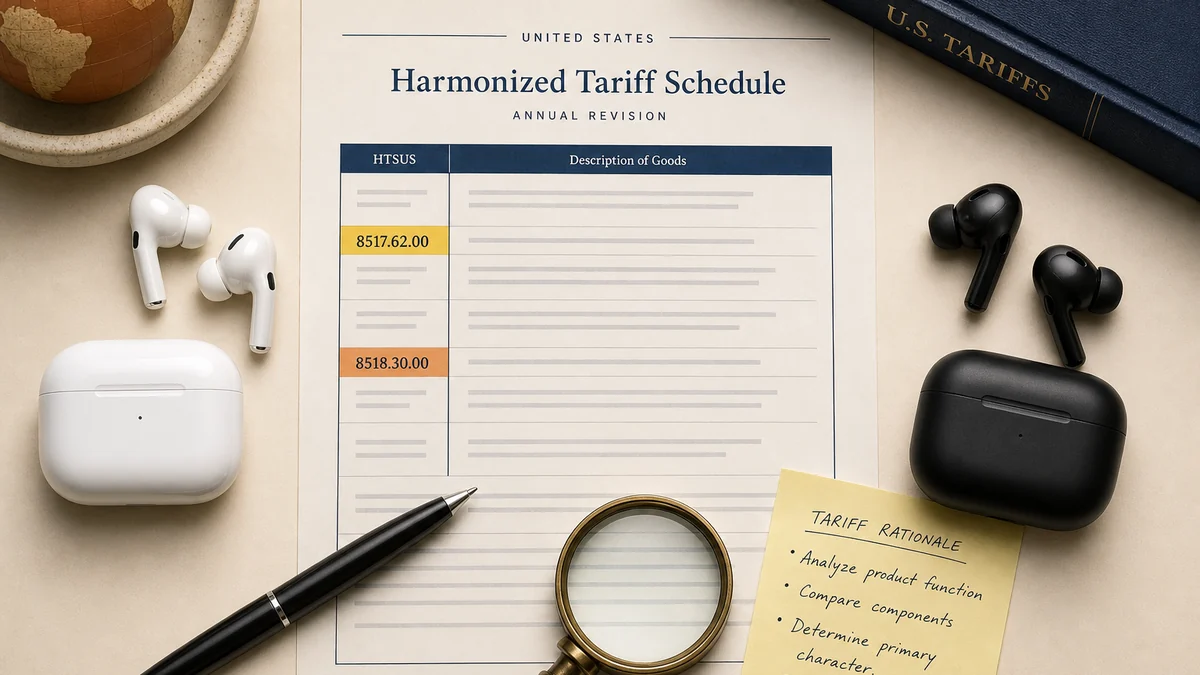
A few months ago a small electronics importer asked us to look at a Bluetooth earbud SKU they were about to start sourcing from a new supplier in Shenzhen. The supplier's quote sheet listed "HTS 8518.30, 4.9% duty." The importer had been using that number across four similar products for two years.
The earbuds in question had no microphone. They were positioned, in the supplier's marketing copy, as "wireless audio receivers" optimized for podcasts. They paired with a phone over Bluetooth and they had no other function.
Was 8518.30 the right code? Maybe. Was it the only defensible code? No. The right answer depended on the General Rules of Interpretation, the chapter notes, and the language CBP had already used in rulings on similar products. Working through that decision is the most useful way to explain how HTS lookup actually works — not as a database search, but as a reasoning exercise.
This piece walks through that process step by step, using a real product, real CBP ruling numbers, and the source trail we'd want to see in any broker-ready packet.
The two candidate codes
The two HTS lines in play for this kind of product are:
8518.30.2000 — "Headphones and earphones, whether or not combined with a microphone, and sets consisting of a microphone and one or more loudspeakers: Other." General rate: 4.9% (per CBP ruling G89845, which classified consumer headsets here). Falls under Section 301 List 3 / List 4A coverage depending on the specific subheading, which means a Chinese-origin product currently carries roughly 7.5%–25% additional duty on top of the MFN rate.
8517.62.0090 — "Machines for the reception, conversion and transmission or regeneration of voice, images or other data, including switching and routing apparatus: Other." General rate: Free in many subheadings. Section 301 coverage is narrower — many telecom and data products in 8517 received exclusions or fall outside the active lists.
The arithmetic difference on a $50,000 PO can run into thousands of dollars per shipment. Multiply by 8–12 shipments a year and a single classification difference is the bonus pool of a small e-commerce team.
So the question is: how do you actually decide?
Step 1: Pull the official source
Open hts.usitc.gov. Search the candidate codes. Capture the exact 10-digit subheading, the description text, the general duty rate column, and the URL. Save the retrieval date as a note.
Three reasons this matters more than it sounds.
The HTS gets revised. The current version is Revision 29 (2025), with the 2026 revision rolling in pieces through the year. If you cite a rate without a date, you can't tell whether it's still valid six months later.
The 10-digit code matters. The 6-digit international heading is the same worldwide. The 8-digit subheading determines US duty treatment. The last 2 digits — the statistical suffix — affect reporting but not duty. Almost everyone shorthand-quotes 6 digits and almost everyone gets bitten eventually.
The general column versus special column. The "General" column shows the MFN rate. The "Special" column shows preferential rates under FTAs (USMCA, CAFTA-DR, etc.). For a Chinese-origin product, the General rate applies — but you should still check the Special column to see whether origin diversification could open a different rate.
Step 2: Read the chapter notes (the step almost everyone skips)
Each chapter of the HTSUS has notes at the start that govern classification within that chapter. Chapter 85 — the chapter both 8517 and 8518 live in — has notes that explicitly address what does and doesn't fall in each heading.
For our Bluetooth earbud question, the relevant notes draw lines around what counts as "headphones and earphones" versus what counts as "data transmission apparatus." A device that primarily reproduces sound for the listener is a candidate for 8518. A device that primarily transmits or routes data — even if sound is the eventual output — leans toward 8517.
The lawyerly answer is that both readings are defensible for Bluetooth earbuds. The empirical answer is that CBP has, in practice, repeatedly classified Bluetooth earbuds without a microphone in 8518 — based on the principal use of reproducing sound for the wearer. CBP ruling N331416, addressing a Bluetooth gaming headset, is one such ruling. CBP ruling G89845 addressed a more conventional headset and reached the same heading.
That history of rulings is informative. It is not binding on your specific product. It tells you where CBP's classification reasoning has landed on similar facts, which lets you build a defensible position rather than a hopeful one.
Step 3: Check CROSS for adjacent rulings
rulings.cbp.gov is the public database of every binding ruling CBP has issued. Search by HTS code, by product description, or by ruling number. A CROSS search isn't going to give you the answer for your product. It's going to show you the language CBP has used when it had to decide a similar question.
For the Bluetooth earbud, the rulings worth pulling are:
N331416 — Stealth C6-100 light-up gaming headset → 8518.30.2000. Useful because it confirms that headphones with auxiliary features (in that case, lighting) still classify as headphones based on principal function.
NY J86357 — A bundle of headphone components from China classified across 8518.10.8030, 8518.30.2000, and 8518.90.8000. Useful because it shows how CBP splits classification when products contain mixed elements.
G89845 — Computer headsets at 8518.30.2000 with the duty rate explicitly stated as 4.9%. Useful because it's the rate confirmation paired with a clear classification rationale.
For each ruling, save the URL and the retrieval date. If the ruling supports your candidate classification, save the specific reasoning passage. If the ruling distinguishes a competing heading, save that passage too — it's often more valuable than the classification answer itself.
Step 4: Apply the General Rules of Interpretation
The GRIs are the legal logic for picking between competing headings. They are at the front of the HTSUS, and they are the rules CBP applies in every ruling. Most importers never read them. Most brokers read them often.
GRI 1 — classify by the terms of the headings and the chapter notes. If your product is squarely described by one heading, you stop here.
GRI 2 — addresses incomplete, unfinished, or composite goods.
GRI 3 — when two or more headings could apply. Subrules: (a) prefer the more specific heading; (b) classify by the material or component giving "essential character"; (c) if neither (a) nor (b) resolves it, use the heading that occurs later in numerical order.
GRI 4 — classify by the heading describing the most kindred article (rare in practice).
GRI 5 — addresses cases and packaging.
GRI 6 — applies the same logic at the subheading level.
For Bluetooth earbuds, the path is usually GRI 1 → 8518 if the product is squarely a headphone/earphone, GRI 3(a) if both 8517 and 8518 are arguable and you have to pick the more specific heading. CBP has consistently treated 8518 as the more specific heading for this product family.

Step 5: Document the decision
This is where the actual broker-ready packet gets built. For the SKU in our example, the entry would look something like this:
SKU classification record Product: Bluetooth wireless earbuds, no microphone, model XYZ-100 Candidate HTS: 8518.30.2000 MFN rate: 4.9% ad valorem (per USITC HTS Revision 29 (2025), retrieved [date]) Section 301 layer: List 3 / List 4A applicability — verify via USTR lookup with 8-digit code, capture URL and date Supporting CROSS rulings: N331416 (gaming headset, principal function reasoning), G89845 (rate confirmation), NY J86357 (component classification) GRI reasoning: GRI 1 — product squarely described by 8518.30; alternative 8517.62 considered but 8518 is more specific for principal-use audio reproduction Origin: China, factory in Shenzhen; substantial transformation analysis [link to supplier declaration] Open questions: Confirm Section 301 9903.88.xx applicability with broker; check whether any active exclusion covers the line under the November 10, 2026 extension Disclaimer: Planning estimate. Final classification at entry. Not legal advice.
Every cell in that record has a source. Every source has a date. If a CBP officer ever asks why the classification was selected, the answer isn't "the supplier said so" — it's a paper trail leading from the GRIs through specific rulings to the specific product.
The mistakes we keep seeing
A few patterns worth flagging, because they show up in almost every classification audit we run:
The supplier-quoted code. The factory in Shenzhen has a default code on its quote sheet. That code may or may not be defensible for a US entry. The factory's incentive is to quote a low rate to close the sale. Verifying the code is the importer's responsibility.
The 6-digit shorthand. "HTS 8518" is not a classification. It's a heading. The duty rate lives at the 8-digit subheading and the statistical detail lives at the 10-digit suffix. A spreadsheet that records 6-digit codes is a spreadsheet that's about to be wrong on an audit.
The stale ruling. A CBP ruling from 2008 might still be technically valid, but the underlying HTS may have been revised, or the Section 301 layer may have changed, or a more recent ruling may have addressed a similar product more directly. Always check whether more recent rulings address the same question before relying on an older one.
The "I'll just use the same code as last time." Last shipment's code may still be right. It also may not be — especially if the product spec changed even slightly, or if the four-year Section 301 review touched the line. A quick re-verification before each new PO is cheap insurance.
When to request a binding ruling
If you're committing to a SKU at meaningful volume — say, $250K+ per year of imports — and the classification has any genuine ambiguity, request a binding CBP ruling under 19 C.F.R. Part 177. The process takes 30–90 days. The result is binding on CBP for the specific product and the specific importer, which means you can plan against it without classification risk.
The trade-off: a binding ruling locks you into a specific classification. If CBP's decision is unfavorable, you've documented your way into the higher rate. So the strategic question before requesting a ruling is whether your defensible argument is genuinely strong. If it is, the ruling cements your position. If it isn't, the binding ruling gives CBP a chance to push you to the higher classification with a paper trail.
A licensed customs broker or trade counsel can help you assess that strength before you file.
Try the workflow on your own SKU using the free HS / HTS lookup. The lookup keeps URLs and retrieval dates by default, which means the source trail builds itself as you work through a candidate classification. Move the candidate into the landed-cost calculator to see how the duty stack lands at current rates.
Planning guide. Not legal advice. Tariff classification is fact-specific. For binding determinations, file a Part 177 ruling request with CBP.
