
In December 2025, Ceratizit USA paid the Department of Justice $54.4 million to settle False Claims Act allegations that it had been declaring Chinese-origin tungsten carbide products as Taiwanese to avoid Section 301 duties. The settlement got a quiet press release. The lesson didn't.
If you're importing from China in 2026, the cost of getting your tariff math wrong is no longer a 5% margin error — it's an enforcement risk. And the math itself just got harder. The Supreme Court struck down IEEPA tariffs on February 20, 2026, but Section 301 wasn't affected. The Federal Circuit affirmed Lists 3 and 4A in September 2025. The Trump–Xi summit on November 1, 2025 extended 178 exclusions through November 10, 2026 — but didn't reopen the request portal. The duty stack now has more layers than at any point since 2018, and the legal ground under each layer is different.
This guide is the checklist we walk through internally before we sign off on any landed-cost number for a China-origin SKU. It's written for three readers: the FBA seller trying to figure out if a 5,000-unit PO still pencils, the small importer who can't afford a $400/hour trade lawyer, and the broker doing 30-second sanity checks on client paperwork. None of this is legal advice. All of it is the bare minimum we'd want to see before a wire transfer leaves a bank.
The 30-second version
Six sources, in order. USITC HTS for the base classification and MFN rate. CBP CROSS for ruling precedent on similar products. The USTR Section 301 portal for the additional duty layer. Chapter 99 of the HTS for temporary measures and exclusions. Commerce/ITC AD/CVD case lookups for trade remedy exposure. And — the one most spreadsheets skip — a final pass for quota, safeguard, and shipment-specific issues that don't show up until your container is at the dock.
Skip any of the six and you're not estimating tariffs. You're guessing.
1. USITC HTS — and why "I copied it from Alibaba" doesn't work
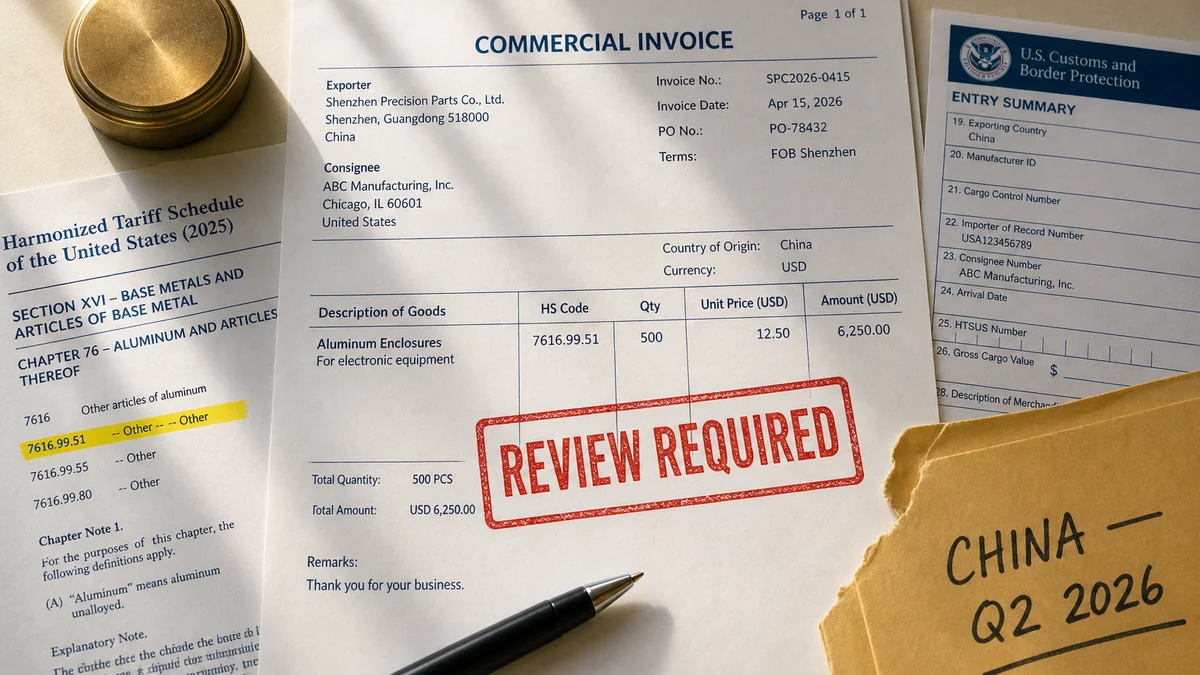
Every duty calculation starts with a 10-digit HTS code, retrieved from hts.usitc.gov. Not from your supplier's pro forma invoice. Not from Flexport's lookup tool. Not from a 2023 spreadsheet a coworker emailed you. The official source, with the retrieval date, captured.
Here's why this single discipline matters more than any other step:
A wireless Bluetooth earbud can be classified under 8518.30.2000 ("headphones and earphones, whether or not combined with a microphone") at a 4.9% MFN rate. A nearly identical product — same form factor, same factory, different feature set — can be classified under 8517.62.0090 ("machines for the reception, conversion and transmission... of voice, images or other data") at a 0% MFN rate. Both classifications have been issued by CBP for products that look indistinguishable on a product page. CBP ruling N331416 put a gaming headset at 8518.30.2000 (Free general rate). Older ruling NY J86357 classified mixed headset components across 8518.10.8030, 8518.30.2000, and 8518.90.8000.
For a $50,000 PO, a wrong classification — say, defaulting to 8518.30.2000 when 8517.62.0090 was defensible — wouldn't change the MFN much in absolute terms. But layer Section 301 on top, and the stacking math swings by thousands of dollars per shipment. Multiply by twelve months and a single classification error becomes the difference between a profitable SKU and a dead one.
So the rule is: pull the HTS line yourself. Capture the URL. Note the date. If you can't justify the 6-digit heading from the chapter notes and the General Rules of Interpretation, mark the row "needs review" and stop calculating.
2. CBP CROSS — the precedent layer most importers ignore
CBP CROSS is a free, public database of every binding ruling Customs has issued. It is the closest thing US trade has to case law, and it is the single most underused resource in import compliance.
CROSS doesn't tell you the right code for your product. It tells you the language CBP used when classifying products like yours, which lets you ask better questions before your entry hits ACE. The questions we run through every time:
- What physical or technical characteristic did CBP key on? (Material? Power source? Principal use? Whether it pairs with a phone?)
- Did CBP explicitly reject a competing heading — and is that rejection language relevant to my product?
- Did the ruling cite the General Rules of Interpretation, the Explanatory Notes, or a prior court decision? (Those reasoning chains often map onto similar products.)
- What does my product do differently — and does that difference move the classification?
A common pattern: an importer finds a CROSS ruling that supports the lower-duty heading, screenshots it, and stops. That's not a defensible position — it's a hopeful one. The defensible position is "we found ruling N331416, here's why our product is materially the same on the three factors CBP relied on, and here's a memo for our broker." Save the URL. Save the retrieval date. Save the comparison.
3. Section 301 — the layer that actually changes your unit economics
Section 301 is where the money goes. Base MFN rates on most consumer products from China are 0–7%. Section 301 layers add 7.5% (List 4A), 25% (Lists 1, 2, 3), or — for strategic categories USTR prioritized in the four-year review — up to 100%.
A few rate moves to know in 2026:
- Semiconductors in HTS headings 8541 and 8542 moved from 25% to 50% on January 1, 2025.
- Lithium-ion EV batteries and parts went to 25%.
- Solar cells and polysilicon wafers are now at 50%.
- Electric vehicles from China carry a 100% Section 301 rate.
- Tungsten products picked up a new 25% tariff that didn't exist before.
For everything else, the rates set in 2018–2020 still apply. List 4A (apparel, footwear, most consumer goods) sits at 7.5%. Lists 1–3 (industrial machinery, electronics components, intermediate goods) sit at 25%. List 4B was never activated.
The verification step: take your 8-digit HTS, run it through the USTR Section 301 lookup tool, and capture the result. The lookup will tell you which list applies, the current rate, and whether an active exclusion covers the line. If the result is "not on a Section 301 list" — verify the country of origin assumption, then move on. If the result lists an exclusion — confirm it's still active under the November 10, 2026 extension. If the four-year review changed the rate, document which effective date applies to your entry.
The mistake we see most often isn't getting the rate wrong. It's quoting one rate and not capturing the URL or date that produced it. Three months later, when an entry posts at a different rate, no one remembers what the original assumption was.
4. Chapter 99 — where the exceptions live
Chapter 99 of the HTS is where temporary measures, special programs, additional duties, and exclusions get parked. It is also where most "but my supplier said the rate was X" disputes end up.
For a China-origin SKU in 2026, three Chapter 99 questions matter:
Does the Chapter 1–97 line for your product cross-reference any Chapter 99 provision? Most Section 301 duties are implemented via Chapter 99 subheadings (the 9903.88.xx series for China). You can't claim or contest one without identifying which 9903 line applies.
Is there an active exclusion? As of the November 2025 trade agreement, 178 exclusions remain active — 164 product-specific plus 14 for solar manufacturing equipment. They run through November 10, 2026. The exclusion request portal is closed — no new exclusions are being granted under this extension. If your product wasn't on the list as of the November 2025 cutoff, you don't have an exclusion path; you have a classification path.
Are there other Chapter 99 layers? Section 232 steel and aluminum duties, Section 122 surcharges, and any IEEPA-related residual notices live in or alongside Chapter 99. The April 29, 2025 anti-stacking executive order changed how some of these layers interact.
If any of those answers come back as "I'm not sure," that's the row that goes to the broker. Not the row you fudge with a "modeled" rate.
5. AD/CVD — the layer that breaks calculators
Antidumping and countervailing duties don't show up in standard tariff calculators because they aren't standard tariffs. They are case-specific, producer-specific, and exporter-specific remedies imposed by the Department of Commerce after dumping or subsidy investigations. Rates can range from 0% to over 400%. They stack on top of MFN, Section 301, and everything else.
For Chinese-origin goods, the categories with current AD/CVD exposure are broad: steel and aluminum products, certain chemicals, hardwood plywood, mattresses, quartz countertops, solar products, tires, and dozens of others. The list changes. New cases get filed. Administrative reviews adjust rates. A producer that wasn't subject to a remedy in 2024 may be subject to one in 2026.
The verification we do before approving any China PO:
- Search the ITC's DataWeb and Commerce's ACCESS portal for active orders that touch your HTS line.
- If you find an active order, identify whether your specific producer/exporter has a separate rate or falls under the country-wide entity rate (the country-wide rate is usually punitive).
- Pull the most recent administrative review results.
- Capture the case number, the order's effective scope language, and the retrieval date.
If your product description even might fall within an order's scope and you don't have a scope ruling that says otherwise, that's a row for trade counsel — not a calculator. The Ceratizit case we opened with started, in part, with origin misrepresentation to dodge Section 301. AD/CVD enforcement actions follow similar patterns.
6. Quotas, safeguards, and the things that don't show up until the dock
The last layer is the one that breaks the most launches: shipment-specific facts.
The "I didn't know that mattered" list — facts that change duty exposure but don't appear on the product page:
- Country of origin under substantial transformation (not the same as country of export).
- Declared value method (transaction value vs. computed vs. fallback).
- Unit of measure (some duties are specific, e.g., $X per kg, not ad valorem).
- Quota status (TRQs on certain agricultural and textile products fill mid-year).
- Safeguard exposure (Section 201, currently active on solar and washing machines).
- Importer of record bond status.
- FDA, FCC, CPSC, or other partner government agency admissibility.
Most of these aren't tariff questions. They're entry questions. But they break landed-cost models the same way an unexpected duty does — by adding cost, time, or a hold that turns a 4-week supply chain into a 14-week one.
The way we handle this in the packet: a single "shipment context" row that gets confirmed by the broker, not modeled. If the broker can't confirm, the entry doesn't go.

How a broker-ready packet actually looks
Here is the format we use internally and recommend to every client running a serious import program. It fits on one page per SKU:
Product: Description, SKU, technical specs, weight, materials, intended use. Classification: Candidate HTS code, source URL (USITC), retrieval date, GRI reasoning, supporting CROSS rulings. Origin: Country, substantial transformation analysis, supplier declaration, supporting documentation. Valuation: Transaction value, FOB/CIF basis, freight, insurance, assists, royalties. Duty layers (each with source + date): MFN base, Section 301 list and rate, Chapter 99 lines, AD/CVD case status, Section 232/122 if applicable. Shipment context: Quantity, UOM, quota check, PGA admissibility, broker confirmation. Open questions: Anything not resolved, flagged for broker or counsel. Disclaimer: "Planning estimate. Final duty determined at entry."
Every cell that matters has a URL behind it. Every URL has a retrieval date. If something can't be sourced, it gets a "needs review" tag — never a guessed number.
The mistake that costs the most
The single most expensive habit we see — and we see it in companies doing $50M+ in annual China imports — is the spreadsheet cell that just says "17.5%" with no link, no date, and no note. It's right today. It might be wrong tomorrow. It gives a broker nothing to review. And if CBP ever asks how that number was arrived at, the answer is silence.
Source-backed planning doesn't make uncertainty go away. It makes uncertainty visible — which is the only state in which it can be priced, hedged, or escalated.
That's the whole point of the checklist. Not to produce a number. To produce a number you can defend.
Apply this checklist to a real shipment with the free HS / HTS lookup and the landed-cost calculator. Both keep source URLs, retrieval dates, and Section 301 layers visible by default — so the packet is the workflow, not the cleanup.
This article is a planning guide, not legal advice. Tariff classification is fact-specific. For binding determinations, request a CBP ruling. For AD/CVD scope questions, consult licensed trade counsel.
